Burning money, not heather: the National Trust's High Peak failure

In a pre-recorded film released to promote the National Trust's work on its High Peak Estate, General Manager Craig Best made a series of claims that range from the misleading to the demonstrably false. The most revealing was his attempt to bracket controlled burning alongside Victorian industrial pollution as a driver of damage to the peatland landscape.
"The peat in this landscape has been damaged from the Industrial Revolution because of acid rain," Best said. "And a whole range of other factors, such as burning, has had a detrimental impact on this landscape."
This is a statement that should embarrass any serious conservationist. Acid rain dumped on the southern Pennines by the coal-fired industries of Sheffield and Manchester was an uncontrolled, decades-long chemical assault on a fragile ecosystem. Cool, controlled burning is a centuries-old management practice, carried out under strict licence by trained practitioners in conditions agreed with Natural England. To place the two side by side, as though they belong in the same category, is not science. It is propaganda. And the man delivering it is the General Manager of a 13,000-hectare estate funded by charitable donations from members who, one assumes, expect a higher standard of honesty.
The irony is that the very landscape the National Trust says it is proud of restoring, the mosaic of heather, bilberry, scattered scrub and grassland that Best describes, was created and sustained by generations of moorland keepers using exactly the management tools the Trust now disowns. Remove that management and the landscape does not stay still. It changes. The evidence from across the uplands is consistent: where rotational burning ceases, fuel loads build, sphagnum is shaded out by rank heather, and the risk of catastrophic summer wildfire rises sharply. None of this is contested by anyone who actually works on a moor.
Marsden Moor: a case study in mismanagement
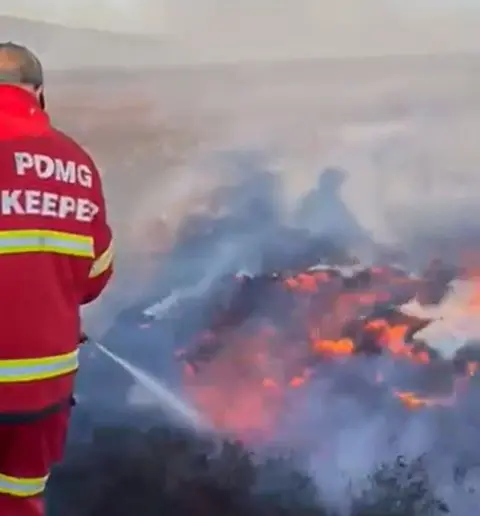
Nowhere is the failure of the National Trust's approach more visible than at Marsden Moor. The Trust's 5,685-acre estate on the Pennine watershed above Huddersfield has, in less than a decade, become one of the most fire-stricken moors in England. Major wildfires in 2019, 2020, 2021 and 2022 burned across thousands of acres of Trust land, in some cases reaching the very same ground twice within eighteen months. The 2019 fire alone scorched around 700 hectares. The Easter 2021 fire ripped through an even larger area and required a multi-day response from West Yorkshire Fire and Rescue, the RAF and volunteer crews. In 2022 the moor went up again, with smoke visible from Manchester.
This is not bad luck. It is a pattern. And it is a pattern that emerged after the National Trust ended traditional management on the estate.
For decades, Marsden Moor was managed with rotational cool burning, grazing and active keepering. Wildfires occurred, but they were containable. Since the Trust assumed direct management and effectively ended that regime, the fuel load on the moor has built year on year, and the consequences have been written across the hillside in black scar after black scar. Each fire has cost hundreds of thousands of pounds to fight, has released decades of stored carbon back into the atmosphere, and has destroyed the very habitat the Trust says it is trying to create. The Trust's own statements after each fire have stressed the climate cost of the burn, the damage to ground-nesting birds and the setback to restoration work. What those statements have consistently failed to acknowledge is the role of the Trust's own management choices in creating the conditions for the fires in the first place.
A working keepered moor next door does not burn like Marsden burns. That is not a coincidence, and pretending otherwise insults the intelligence of anyone who has stood on the boundary and looked at the contrast.
Where has the money gone?
The financial picture is, if anything, more damning than the ecological one. The National Trust spends in the region of £6 million a year on restoration in the High Peak. Over the five-year window in which Best reports eight hen harrier nesting attempts, that is £30 million of charitable and grant-funded money. Add in the parallel spending on Marsden Moor restoration, the peatland schemes funded through Defra's Nature for Climate Peatland Grant Scheme, the MoorLIFE and MoorLIFE 2020 partnership funds, lottery contributions and the Trust's own donor appeals, and the total committed to the National Trust's southern Pennine moors over the past decade runs comfortably into the tens of millions, and quite possibly higher.
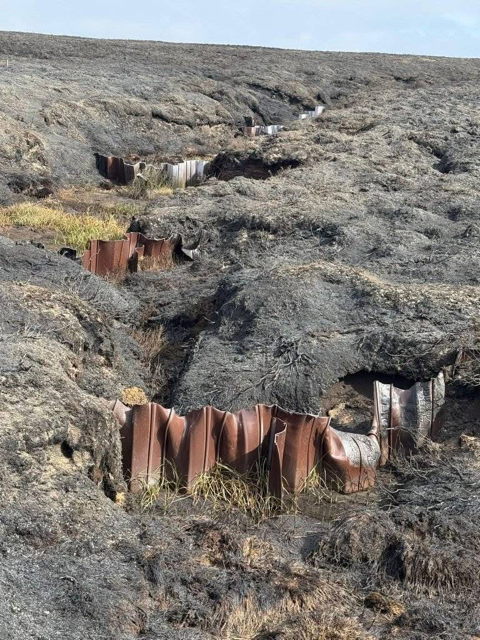
What has that bought? A handful of hen harrier nesting attempts. A stated ambition of two to three successfully breeding pairs within five years. Repeated catastrophic wildfires on Marsden, Bleaklow, Howden and Kinder Scout. Restoration projects whose physical infrastructure, the gully blocks, the sphagnum plugs, the heather brash, has in many cases been destroyed by the first serious fire to pass through. Sphagnum plugs cannot survive a fire front that scorches the peat beneath them. Heather brash spread to revegetate bare ground simply adds fuel to the next blaze. Years of restoration, gone in an afternoon, paid for by the public and the Trust's own membership.
By any normal standard of financial accountability, this is a charity spending vast sums to produce outcomes that are then routinely written off by fires that competent management would have made survivable. If a private estate were burning through donor and taxpayer money at this rate, with this little to show for it, the National Trust would be the first to demand answers. Yet because it is the National Trust itself, the same questions are not asked.
National Trust members might reasonably want to know how much of their subscription has been spent on heather brash that is now ash. They might want to know what proportion of restoration on Marsden Moor has been destroyed and re-funded more than once. They might want to know whether the Trust has ever published a hectare-by-hectare audit of restoration losses to wildfire on its High Peak estate, and if not, why not. They might also want to know how much of the £6 million annual budget is spent on the communications and advocacy that produced Best's film, as opposed to the keepering, cutting, grazing and fuel-load management that would actually protect the peat.
The contrast with privately funded managed grouse moors is, frankly, embarrassing for the Trust. On those estates, comparable or better conservation outcomes are delivered at a fraction of the cost, alongside a working rural economy that supports keepers, contractors, hauliers, agricultural suppliers and local pubs. The hen harrier recovery in England is being driven from those moors, not from National Trust land. The wildfire record on those moors is, year after year, dramatically better than on the Trust's neighbouring holdings. None of this features in the film.
The persecution narrative
The persecution narrative deserves a word too, because it is the National Trust's standard rhetorical move when results disappoint. Best states that "when those birds fly off, the trouble starts," implying without evidence that hen harriers fledged on National Trust land are then killed by neighbouring landowners. This is a serious allegation to make in a public film, and an irresponsible one. Satellite tagging data, including from Natural England's own monitoring programme, shows hen harriers travelling across multiple estate types and habitats, with losses occurring in a range of locations and circumstances, including on land with no shooting interest at all. Implicitly blaming an entire community of neighbouring land managers, the very partners the Trust claims to want to work with, is not a basis for partnership. It is a slur, deployed to deflect attention from the Trust's own failures on its own ground.
A reckoning is overdue
Genuine peatland restoration should be welcomed. Sphagnum planting, gully blocking and grip damming are valuable interventions, and many of the techniques the National Trust now claims as its own were developed in close cooperation with moorland keepers across the north of England. What we cannot accept is the quiet rewriting of upland history in which traditional management is recategorised alongside industrial pollution as a cause of damage, while the organisation doing the rewriting watches its own moors burn. The peat soils of the High Peak survived two and a half centuries of acid rain. They did so on landscapes that were burned, grazed and keepered. They are not surviving the National Trust.
The High Peak deserves better than a General Manager who confuses management with pollution, a charity that spends millions to deliver outcomes a working estate would consider modest, and a communications strategy that blames the neighbours every time the figures fail to add up. Marsden Moor deserves better than to keep burning in the same places, in the same way, for the same reasons, year after year, while the body responsible for it tells the public the strategy is working. And National Trust members, the people actually paying for all this, deserve a full and honest account of how much of their money has been spent, how much has been lost to fire, and why the organisation refuses to use the tools that would protect the rest.