


Friends of the Dales has questions to answer yet its chair, Jonathan Riley, seeks further obfuscation.

Earlier this week we published an article into Friends of the Dales and the question of who is really driving its "Eyes on the Skies" campaign. We documented, in detail, how a small Yorkshire charity with a pleasant-sounding mission appeared to be functioning as a public-facing vehicle for a coordinated national lobbying operation that relied on RSPB evidence, RSPB speakers, and RSPB political objectives, while presenting itself to the public and the Charity Commission as independent community engagement.
The allegations we raised were serious. We showed how the petition launched at a Friends of the Dales webinar cited RSPB analysis as its evidential foundation. We showed how Jonathan Riley himself, as Chair of Trustees, opened one of those webinars by setting out explicitly political goals: making wildlife crimes notifiable, strengthening sentencing, and licensing the gamebird shooting industry.
We documented how a serving detective was given a platform to brand moorland estates as the subjects of serious organised crime investigations, without charges, without convictions, and without any right of reply.
We raised concerns about advice given to raptor monitors that appeared to encourage covert surveillance on private land. And we asked the question that any serious examination of this organisation must ask: can a registered charity, whose own governing document requires it to serve the Yorkshire Dales community, including the gamekeepers and moorland workers who live and work there, legitimately be used to run what amounts to a political campaign against a lawful rural industry?
These are not trivial questions. They go to the heart of what Friends of the Dales is, what it is for, and whether its trustees are meeting their legal obligations.
Jonathan Riley's response? A complaint about his photograph,which he has subsequently deleted.
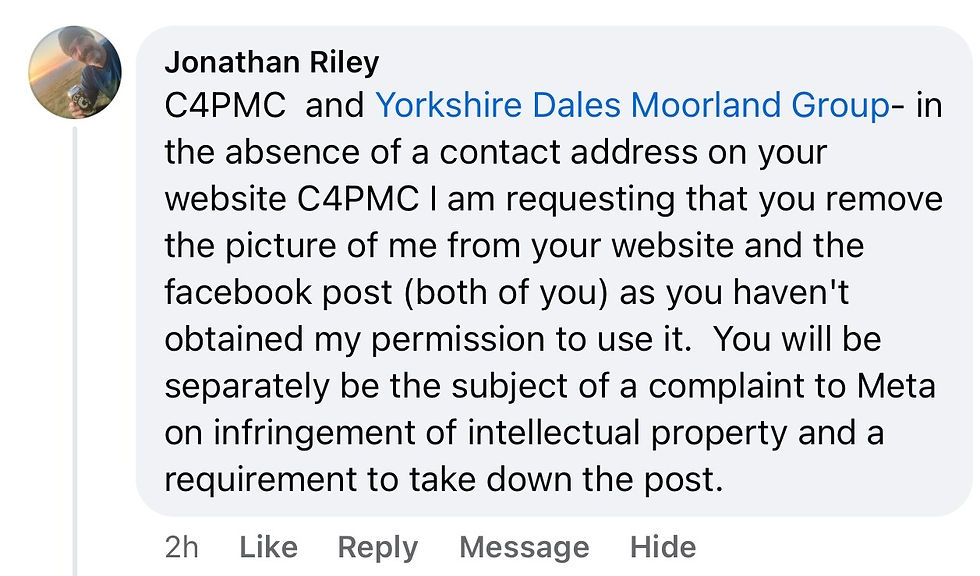
Let us be clear about what that response represents. Rather than engage with any of the substance of our investigation, rather than offer a single word of explanation, correction, or counter-argument on the matters of real public concern, the Chair of Trustees of a registered charity has chosen instead to attempt to deploy a minor procedural grievance. It is the equivalent of a company director, facing questions about the conduct of his organisation, responding by querying the font size on the letterhead.
On the photograph itself, it seems he misunderstands public interest. Jonathan Riley is the Chair of Trustees of a registered charity. He opened public-facing webinars in that capacity. He made statements on the record, in his role as trustee, setting out the campaign's political objectives. He is, in the most straightforward sense, a public figure acting in a public role on a matter of significant public interest. The use of his photograph in that context falls squarely within the public interest provisions that govern such matters. A trustee who steps forward to open a political campaign webinar cannot simultaneously claim the privileges of a private individual when scrutiny follows.
But the photograph is not the point. The point is what Riley's response reveals about how Friends of the Dales and its board intend to handle the questions that have been put to them.
It reveals a board that has decided not to answer. Not because there are no answers to give, though one might wonder, but because engaging with the substance would require the trustees to either defend positions that are genuinely difficult to defend, or to acknowledge that Friends of the Dales has strayed far beyond the charitable purposes it is registered to pursue. Neither option is attractive, so instead the board has reached for the most readily available displacement activity: a procedural complaint designed to shift the conversation onto process rather than substance, and to position themselves as aggrieved parties rather than trustees with questions to answer.
It is the tactic of organisations that have something to hide and hope that noise about process will drown out the signal of accountability. It does not work, and it should not be allowed to work.
The board of trustees of Friends of the Dales has a legal responsibility, not a discretionary one, to ensure that their charity operates within the law, within its governing document, and in the interests of its charitable purposes. The Charity Commission is explicit that trustees cannot shelter behind their executive director when questions are raised about the direction of the organisation. They are personally accountable for the use of charitable funds, the conduct of charitable activities, and the independence of charitable decision-making. Jonathan Riley, as Chair, carries the highest degree of that accountability.
The questions that remain on the table are these. Did the board of trustees sanction the use of Friends of the Dales as a platform for a campaign built substantially on RSPB evidence and RSPB political objectives? Did the board consider whether that was consistent with the charity's stated independence from financial and political affiliations? Did the board review the content of the webinars before they were hosted, and if so, did they consider the legal, reputational and community harm implications of the advice given to attendees about covert surveillance? Did the board satisfy itself that launching a petition with explicitly regulatory demands during a charitable education event was consistent with Charity Commission guidance on political activity? And did the board consider whether inciting hostility towards the gamekeepers and moorland workers who are themselves members of the Yorkshire Dales community is compatible with a charitable mission to protect and enhance that community?
A complaint about a photograph answers none of these questions. The board's silence on all of them is, in its own way, an answer.
We will continue to report on this matter. We note that the Charity Commission has made its position on the capture of charitable organisations by narrow political interests very clear. We note too that the communities our readers represent, the gamekeepers, the land managers, the moorland workers, the farmers, are precisely the communities that Friends of the Dales is constitutionally required to serve. They deserve trustees who take that obligation seriously.
Jonathan Riley and the board of Friends of the Dales have a choice. They can continue to hide behind procedural complaints and hope the scrutiny fades. Or they can do what trustees of a properly governed charity should do when serious questions are raised: answer them.
We suggest they choose the latter.


